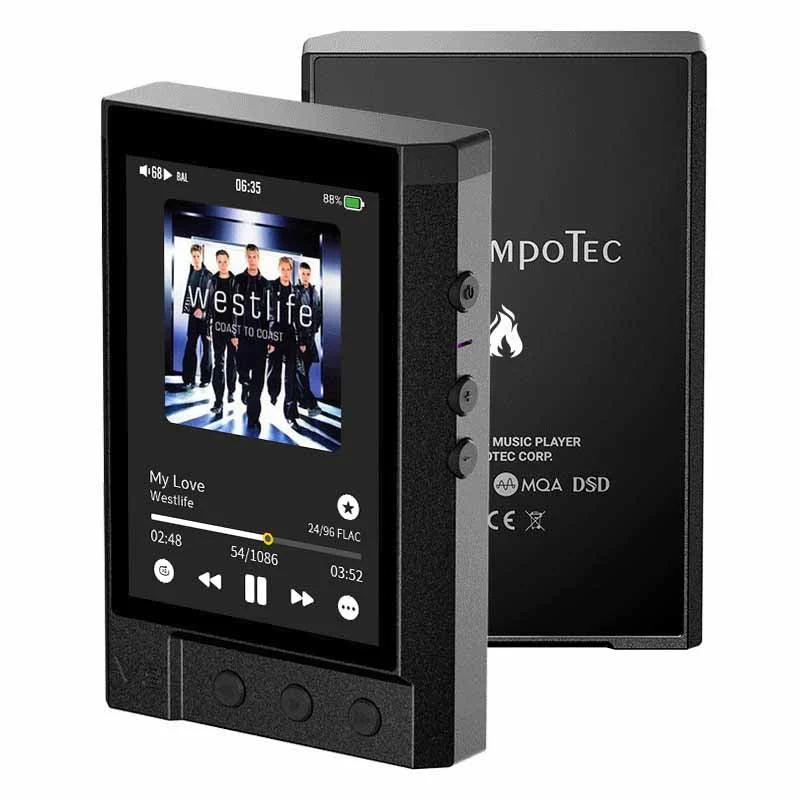
The TempoTec V3 Blaze is easy to frame the wrong way. You can look at the modest screen, the chunky little chassis, the stripped-down HiBy-based interface, and the lack of modern Android flash and conclude that this is just another budget digital audio player trying to borrow seriousness from a long feature list. That reading misses what makes it interesting. The V3 Blaze is more credible as a machine for people who still care first about output power, transport flexibility, and getting to music without turning the whole experience into a tiny, battery-draining smartphone.
This is a compact $199 class player built around dual AK4493SEQ DAC chips, a 4.4mm balanced output rated at 825mW + 825mW into 32 ohms, a 3.5mm single-ended output, USB DAC support, USB digital output, microSD playback, 2.4GHz Wi‑Fi, two-way Bluetooth 5.1, and a deliberately simple operating system. The most sensible angle is not to ask whether it beats every shinier rival on polish. It is to ask whether it offers one of the smarter pure-audio value propositions in its range. I think it does, with a few clear caveats.
The angle: this is a utility-first DAP for listeners who care more about sound and power than software theatre
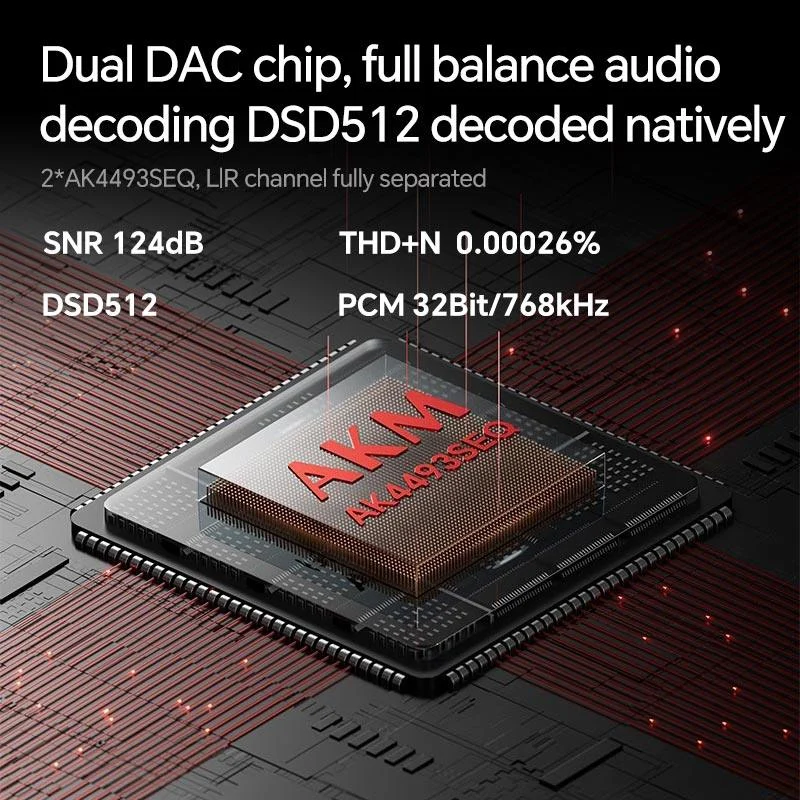
That angle matters because the V3 Blaze sits in a part of the market where buyers are constantly tempted by prettier interfaces and broader app ecosystems. TempoTec has chosen a different lane. Official materials lean heavily on the hardware story: dual AK4493SEQ DACs, dedicated low-pass filtering via OPA1652 chips, four SGM8262 op-amps, FPGA clocking, and a battery rated at 3500mAh. The result is not a luxury object so much as a compact power tool for portable listening. If that sounds slightly unromantic, it should not. There is something refreshing about a player that knows its audience.
The right audience is fairly clear: listeners who want a dedicated player that can handle IEMs easily, drive a surprising range of full-size headphones, work as a USB DAC when needed, and stream enough to remain useful in 2026. The wrong audience is the buyer who wants a mini Android tablet in their pocket, full app freedom, and smartphone-grade fluidity. The V3 Blaze is not trying to charm that person, and it probably will not.
Design and hardware: compact, slightly chunky, and more purposeful than glamorous
Physically, the V3 Blaze sounds and looks more pragmatic than luxurious. TempoTec lists dimensions of 10 x 6.5 x 1.7 cm: pocketable, solid, and a little brick-like. This is not the kind of DAP designed to disappear in the hand. It is the kind that reassures you it contains real amplification.
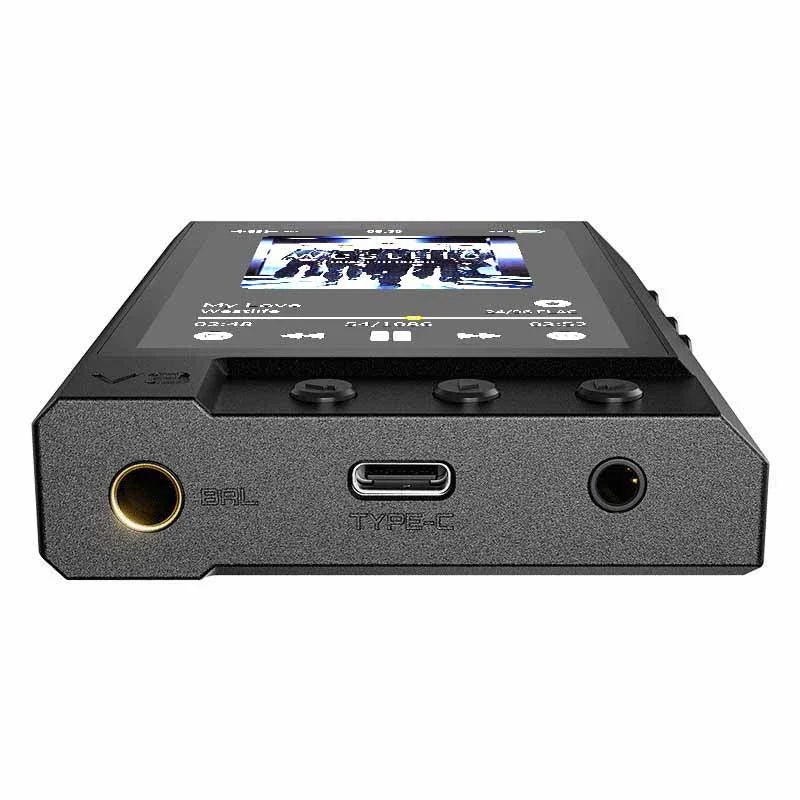
That purposeful feel extends to the hardware layout. You get both 4.4mm balanced and 3.5mm single-ended outputs, and both can be switched to line-out in software. There is also USB-C for charging, USB DAC duty, and digital output to an external DAC. On paper, that versatility is one of the V3 Blaze’s best arguments. In practice, it makes the device easier to justify because it can live several lives: portable player, bedside source, transport, or simple DAC/amp for a laptop or phone.
The tradeoff is that the industrial design does not hide its compromises. The build is good, but the player is heavy for its size, the screen is occasionally stubborn, and the case protects well while making some front controls harder to press. None of that is fatal. It does, however, reinforce the core thesis: the V3 Blaze is better understood as a competent audio device first and a sleek lifestyle gadget second.
Features and usability: enough modern convenience, but no illusion of smartphone polish
TempoTec’s own pages make the feature set sound almost unusually broad for the money: TIDAL and Qobuz support, DLNA, AirPlay reception, HiByLink remote control, microSD playback, Bluetooth codecs including LDAC and aptX variants, PCM up to 32-bit/768kHz, DSD512, and MQA decoding claims depending on the listing. The useful takeaway is not to obsess over every badge. It is that the V3 Blaze has enough modern connectivity to avoid feeling stranded in a local-files-only past.
Still, this is not the sort of player you buy for silky software. The operating system is simple, pragmatic, and limited compared with Android-based rivals. That can read as a criticism or as a design choice, depending on what you want. If your idea of portable audio joy is a lean interface that boots into music quickly and avoids background clutter, the simplicity is part of the appeal. If you expect the flexibility and visual smoothness of a more app-centric machine, the same simplicity will feel like a ceiling.
TempoTec made the right compromise for a certain kind of buyer. The OS is basic but usable, with stable enough streaming and remote-control features to stay relevant. That matters more here than visual flair. The V3 Blaze does not need to be the most beautiful interface in the room if it is dependable and sonically worthwhile.
Power is the headline feature, and it seems to be earned
If there is one reason to pick the V3 Blaze, it is amplification. TempoTec claims up to 1650mW through the 4.4mm output at 32 ohms, and with harder-to-drive headphones this is an unusually muscular little player. It handles Sennheiser’s HD 550 and even HD 600 comfortably, though sheer voltage swing does not magically solve every low-sensitivity load.
That matters because many affordable DAPs are easy to oversell and harder to live with once you move beyond efficient IEMs. The V3 Blaze avoids that trap. It is not a desktop replacement in every scenario, but it is genuinely more capable than the usual compact-player stereotype. For listeners who switch between in-ears, portable headphones, and the occasional full-size dynamic set, that extra headroom is not marketing fluff. It is the thing that turns a niche device into a useful one.
How the TempoTec V3 Blaze sounds
The encouraging part of the V3 Blaze story is that the sound justifies the hardware emphasis. It is not ultra-clinical, hyper-etched, or trying to manufacture detail with treble glare. It has a more mature balance: clean, energetic, slightly warm through the AKM flavor, and musical without turning soft or syrupy.
The player sounds vibrant, weighty, and broadly natural, with a touch of warmth and a more intimate stage than the best technical performers. It is close to neutral and natural rather than analytical, with strong timbre, convincing imaging, and better-than-expected overall sound quality for the price. The V3 Blaze is not tuned for sterile hi-fi posturing. It is tuned to sound grounded, capable, and easy to enjoy across long sessions.
That is a stronger position than it might first appear. In the sub-$200 to $250 source category, it is very easy to impress people briefly with brightness, pseudo-detail, or a flashy tonal edge. It is harder to sound convincing over time. The V3 Blaze leans toward note weight, usable dynamics, and enough control to make both IEMs and headphones feel properly fed. It may not be the last word in stage width or microscopic separation, but the larger point is that few buyers at this level actually need that from a player like this.
Battery life, connectivity, and day-to-day ownership
Battery claims for portable players are always slippery, but with its 3500mAh pack the V3 Blaze lands in a respectable rather than miraculous place. Official material points to roughly 10 to 20 hours depending on mode; typical use comes in at a little over 10 hours, with streaming cutting that down. That is more useful than a heroic number nobody can reproduce.
Wireless support is also more competent than token: stable Bluetooth and workable Wi‑Fi streaming, with AirPlay and DLNA adding flexibility for people who want the V3 Blaze to play nicely with the rest of the house. The presence of only 2.4GHz Wi‑Fi is not elegant in 2026, but the connection stays stable, so it is a limitation you note rather than one that ruins the product.
Who should buy it, and who should not
The best case for the TempoTec V3 Blaze is straightforward. Buy it if you want a dedicated music player with real output power, practical wired and wireless versatility, and a sound signature that aims for natural engagement rather than empty fireworks. Buy it if you like the idea of a compact DAP that can also behave like a USB DAC or transport without drama. Buy it if you are willing to trade software glamour for hardware seriousness.
Be more cautious if you want a luxury-feeling UI, the broad freedom of Android app culture, or the slimmest and slickest object in the category. Also be cautious if you are expecting raw power numbers alone to make every difficult headphone portable-friendly. The V3 Blaze is impressively strong for its size, but physics still exists.
Final verdict
The TempoTec V3 Blaze is not the most luxurious player in its class, and it does not try very hard to pretend otherwise. What it offers instead is a more believable kind of appeal: serious output for the money, enough connectivity to remain flexible, and a sound that comes across as thoughtful rather than gimmicky. That combination makes it easier to respect than some more glamorous rivals.
If your priorities line up with its strengths, the V3 Blaze is one of the smarter budget-to-midrange DAP buys around. It is a pragmatic little brick, but sometimes that is exactly what a good audio product should be.